

.png)
.png)
.png)
Achillea millefolium: Common Yarrow
Updated: Jul 19

Yarrow
Achillea millefolium L.
Common (English) Names: Common yarrow, Soldier’s Woundwort, Bloodwort, Devil’s Plaything
French Names: Herbe à dinde (herb for turkeys, referring to its use in France as turkey fodder), Herbe Militaris (military herb)
Gaelic Names: Athair thalún (Father of the Earth), Lus na fola (Herb of the Blood)
Cree Names: astaweskotawan (to put out a campfire, as in burning pain), mistigonimaskigiah (head medicine), asgunimasgigah (bone medicine)
Chipewyan Name: t’ àchay delagi (holy flower)
Etymology:
It is obvious, upon even the quickest of research, that Yarrow was revered by many, many cultures around the globe. This is evident in the study of etymology- Yarrow has many, many names, a phenomenon that is associated with widespread cultural reverence. Even in the briefest look at these names, as listed above, tells a story. Yarrow is the Father of the Earth, the Holy Flower. It is medicine of bone and of blood. The more you learn about this incredible species, the more you begin to understand why.
- Millefolium stems from the Latin words ‘thousand’ and ‘leaf’.
- The story of Achillea is one that changes depending on who is telling it. There are several proposed connections between Achilles and Yarrow, most of which are sparse in detail and simply draw the connection between his time as a military general, and Yarrow's use in the military. I prefer the story of what I like to call Achilles and His Hubris- a less common version of the myth, that conveys an important lesson about this incredible plant. The myth begins the same as the version we all know- The baby Achilles, born of Thetis, a sea nymph, is dipped into the River Styx by his mother in a desperate and dangerous attempt at making him immortal. This achieves his invulnerability, but unbeknownst to both, he remains vulnerable at his heel, his ‘Achilles tendon’, where Thetis held him as she submerged him in the River.
In his youth, he trains with the Centaur Chiron, who boasts of a long life spent mastering a great deal of skills; one of them being herbalism. Achilles becomes a master of herbalism.
Jumping ahead to his adulthood, we see Achilles as a general in the Trojan War. He heals his fellow troops with his herbal knowledge, and extensively uses Yarrow to treat wounds and infections. During the war, he kills the son of Apollo. He also kills a Trojan Prince. Not long after, the cowardly brother of the prince ‘faces’ Achilles in battle. From a great distance, he shoots an arrow, which is then guided by the god Apollo, that strikes Achilles in the back of his ankle.
In my preferred version of the myth, Achilles does not die instantly. The arrow is not poisoned, he is not struck down. But he is injured. He escapes the battle, but is convinced that he is unharmed. That he will heal. He believes, and historically has had every reason to believe, he is completely invulnerable. That he cannot be hurt. He never has been before. He refuses to treat himself. Refuses the Yarrow and other herbs that are offered to him. The wound festers. The infection spreads. And Achilles dies in a field of Yarrow, so consumed by his hubris he could not see the answer right in front of him.
Species of Interest: There are thousands of species in the genus Achillea. The majority of documentation and modern research, however, refers to A. millefolium. There are two other yarrow species native to our area, namely A. borealis and A. alpina. The specifics of these phenotypes is not something I find necessary to get into. There is a debate, horticulturally speaking, about how we classify these species. But in terms of medicine, it does not matter. All three species of Yarrow found here are considered medicinal in similar measure. There are many varieties of A. millefolium available in garden centres- pinks, oranges, yellows, etc. These are generally considered weaker variants in terms of medicinal compounds. These varieties have a tendency to revert back to white.
Zone: Hardy to zone 3 (some argue to zone 2)
Native to: Temperate regions across the Northern Hemisphere; in North America, Europe, and Asia.
Family: Asteraceae, the aster family (previously Compositaceae)
Botanical Description:
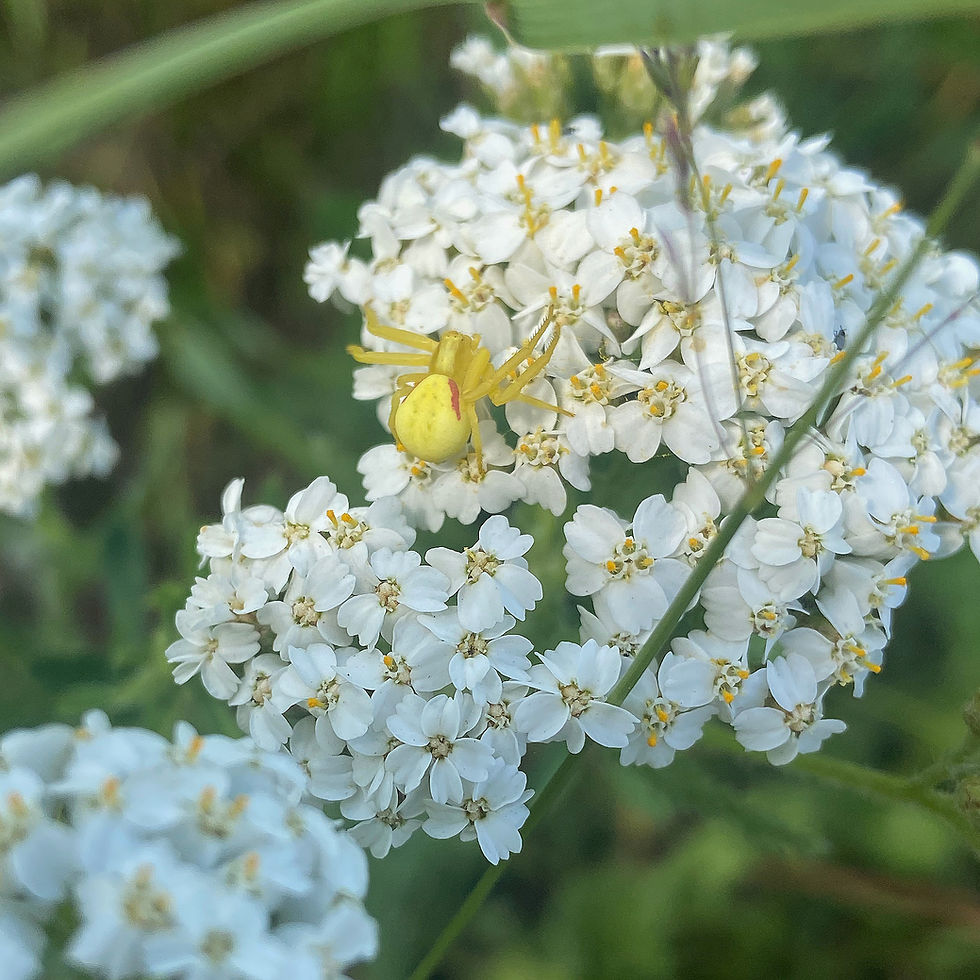
- Flowers: White, composite flowers emerging from the stem in a flat-topped corymb. Ray flowers have 5 petals each. Florets have 5, inconspicuous petals, and have a butter yellow to bright yellow pistil (female reproductive system). The stigma is bilobed.
- Leaves: Alternate, 3 to 4 inches long and 1 inch broad, clasping the stem at the base. Leaves are bipinnate, with finely cut segments, giving the leaves a feathery appearance. Leaves have a faintly herbal, spicy aroma when crushed.
- Stem: Angular, rough to the touch.
- Roots: Orange to brown in colour. Fibrous roots, spreading rhizomatically.
Look-Alikes: Queen Anne’s Lace, Poison Hemlock
Ecological Niche:
Yarrow’s flower clusters boast richness of nectar and a long bloom time, making them extremely attractive to a huge number of pollinators and other insects looking for food. They are incredibly valuable to native bees, which, for me, is almost enough said. Other insect associations of Yarrow include beneficial spiders (especially crab spider), flies, leaf beetles, tumble flower beetles, grasshoppers, and weevils. Larvae of moths such as the Yarrow Plume Moth (Gillmeria pallidactyla), Stalk Borer Moth (Papaipema nebris), Blackberry Looper (Chlorochlamys chloroleucaria), Wormwood Pug (Eupithecia absinthiata), Common Pug (Eupithecia miserulata), Wavy-lined Emerald (Synchlora aerata), and others feed on flowers, stems, leaves, or bore into tissues. Yarrow is also a frequent food source of many larger animals- ungulates, sheep, antelope, rabbits, ground squirrels, wild turkeys, etc. Yarrow truly is a keystone species for animals big and small- serving as a reliable source of pollen & nectar, and structural nesting microhabitats.
Yarrow is also a heavy hitter in terms of erosion control, and nutrient cycling/ soil improvement. It is extremely hardy and can become aggressive in disturbed sites. It is also mildly allelopathic- meaning it releases hormones through its roots that limit the ability of other plants to germinate, grow, and thrive. These adaptations allow Yarrow to hold down the fort against invasive non-native species.
Parts used: Aerial parts.
Harvest: Harvest leaves ideally before flowering, but can be harvested throughout the season. Harvest flowers when in full bloom.
Cultivation: Weedy, but beautiful. Makes an excellent cut flower. Attracts beneficial parasitic wasps, so makes an excellent garden companion (if controlled). It creeps steadily through its rhizomatic root system. Seed germination rate is high, sitting at around 80-92%.

Mackenzie leading the Field Notes & Folk Stories Plant Walk
at Bunchberry Meadows, 2025.
In Folk Medicine
Primary Indications: Staunching bleeding (external and internal). Fevers. Toning hemorrhoids and varicose veins. Postpartum care. Leaking gut, bleeding ulcers, and other digestive concerns. Loss of appetite. High blood pressure.
Actions: Hemostatic, Antiseptic, Diaphoretic, Carminative, Bitter, Hypotensive, Astringent, Diuretic, Antiseptic, Anti-Inflammatory, Anti-fungal, Antispasmodic, Aromatic, Astringent, Diaphoretic, Febrifuge, Styptic, Vulnerary.
Energetics: Bitter, warm, dry.
Active Constituents: Volatile oils (including azulene, borneol, eucalyptol, camphor), Sesquiterpene lactones, Tannins, Flavonoids (such as apigenin), Alkaloids (such as achilleine), Phenolic acids, Coumarins
Preparations: Poultice, compress, powder, liniment, infused oil, salve, tincture.
Infusion: 1-2 tsp/ cup of water. Steep 15+ minutes (as bitter as you can handle). Drink 1-3 cups daily. When feverish, take hourly.
Tincture: take 2-4 ml up to 3x/daily.
Folk Wisdom: As mentioned above, yarrow has been honored and harvested throughout history wherever it grows. In Europe, there is evidence and documentation suggesting yarrow was used in nearly every region before written history. Pollen and plant remains found in 60,000 year old Neanderthal burial sites suggest yarrow was used as a medicinal or ritual plant during the Neolithic and Bronze Ages. We can assume, through surviving tradition, that the Gaelic and Brythonic peoples highly revered Yarrow. This is evident by its surviving names (Father of the Earth, Herb of the Battlefield, etc.), as well as surviving cultural traditions involving Yarrow- its incorporation during Beltane and Litha rituals, divination using dried stalks, etc. Yarrow was also culturally revered by the Greeks, Romans, and Norse peoples. In general, Yarrow’s history is interwoven into the history of nearly every European military. It was harvested and used extensively, primarily in its powdered form, for battle wounds; to pack bullet wounds, treat infections, etc. Yarrow is also mentioned in Tibetan and Himalayan folk healing traditions. In more recent history, Yarrow was assimilated into the Ayurvedic tradition. In pre-contact North America, usage of Yarrow was equally widespread. For many tribes, this plant had a key role in both medicine and ceremony. While preparation and dosage varied greatly across different communities, it is extremely relevant to note that the intended usage of Yarrow remained very similar. This lends itself greatly to the verification of this plant's medicinal effects. Consistently, yarrow was used for wounds and bleeding, infections, minor skin irritations, fevers, and digestive concerns.
Contemporary Research: Recent research supports many of the traditional uses of this plant. The largest amount of data has been accumulated for its use as an antioxidant and anti-inflammatory. There are also positive results on the analgesic, anti-ulcer, choleretic, hepatoprotective and wound healing activities. First positive results on other interesting therapeutic areas - antihypertensive, antidiabetic, antitumor, antispermatogenic activities -need confirmation. Research also indicates it can be used also as an insect repellent.
Folk Cookery Traditions
Culinary Uses: Yarrow is my absolute favourite wild green. It can be eaten raw, as an excellent herby addition to salad, pesto, and green smoothies. It is delicious fresh in soups, stews, and skillets. I like keeping some dried on my spice rack to add to nearly everything I cook. I love it on roasted chicken and other white meats. Add yarrow to anything you are adding ‘Italian style’ herbs to. It pairs excellently with Sage, Rosemary, Oregano, Lamb’s Quarter’s, and Garlic. It has a delicious sagey, herbal flavour.
Folklore & Sacred Correspondences
Key Themes: healing the weary heart and soul, protection from evil, divination (particularly of love), dream work, abundance.
Key Archetypes: The Wounded Healer and Wounded Warrior. The Weavers. The Oracle. Guardian of Thresholds. Goddesses of Love & War.
There is extensive reference to Yarrow in folklore traditions around the world. In Greek myth, the story of Achilles, in all its versions, is interwoven with Yarrow. It is also associated with Achille’s mentor, Chiron. Chiron was, at times, called ‘The Wounded Healer’, and Yarrow is deeply linked with the concept. It is considered to be a sacred healer of healers- all those who live life in service to others. In a spiritual sense, it is often employed to ‘staunch a bleeding heart’.
In North mythology, yarrow belonged to the magical ‘repertoire’ of herbs gifted to man by the Gods for protection in battle. This theme follows Yarrow across many, many cultures. It is considered sacred for warriors, not only for its healing prowess, but as a powerful protection against evil and harm.
It is said that the Irish would never dare harvest Yarrow without reciting a poem, prayer, or incantation. One such Gaelic prayer, titled The Yarrow, is ascribed below, as it was translated by Carmichael in the Carmina Gadelica Vol. 2:
“I will pluck the yarrow fair
That more benign will be my face,
That more warm shall be my lips,
That more chaste shall be my speech,
Be my speech the beams of the sun,
Be my lips the sap of the strawberry.
May I be an isle in the sea,
May I be a hill on the shore,
May I be a star in the waning of the moon,
May I be a staff to the weak.
Wound can I every man,
Wound can no man me.””
Throughout European history, Yarrow is associated with Seers, Oracles, Fortune Tellers, etc. It was frequently hung over thresholds and above the bed as a protection charm. Eventually, it became synonymous with ‘The Witch’s Herb’. This was not necessarily a positive association historically; eventually, Yarrow was considered to be a herb belonging to ‘the Evil One’. Some names given to it during this time include Devil’s Plaything and Devil’s Nettle. An old superstition states that Satan would walk the streets at night and shake yarrow at the homes of those he wished to curse with bad luck (this tidbit of plant lore never ceases to make me laugh when I think about it). As late as the 17th century, a woman was tried as a suspected witch for using yarrow. This association did not necessarily stop these folk traditions from continuing.
It did not help that the traditions of these plants were often kept alive by young women and girls. It was greatly associated with love & relationship divination, like in this example from The British Isles:
An ounce of Yarrow sewed up in flannel and placed under the pillow before going to bed, having repeated the following words, brings a vision of the future spouse:
'Thou pretty herb of Venus' tree,
Thy true name it is Yarrow;
Now who my bosom friend must be,
Pray tell thou me to-morrow.'
Many such incantations are recorded, cementing Yarrow’s association to love magic. Several more of these prayers are translated as follows:
From Aberdeen:
On Beltane, always in silence, young girls gathered in fields to harvest Yarrow. Then they would shut their eyes and pull what first came to hand, repeating:
“O it’s a bonnie May morning,
I cam’ t’ pu’ the yarrow;
I hope before I go
to see my marrow.”
Another, from Aberdeen:
“Good morrow, good morrow,
To thee, braw yarrow,
And thrice good morrow to thee;
I pray thee tell me today or tomorrow
Who is my true love to be.”
The girls would then open their eyes, and if they were to lay eyes on a single man, they would be married to him before the end of the year.
In Massachusetts:
While walking three times around the Yarrow plant, young girls would recite:
“Good evening, good evening, Mr. Yarrow.
I hope I see you well tonight,
And trust I’ll see you at a meeting tomorrow.”
Then the girls would pluck the blooms, put them inside the dress, and sleep with them. The first man they met the next day at church would be their husband.
The herb is also considered sacred to many groups Indigenous to Native America. Among the Anishanaabe, yarrow is highly honoured. In her book, Mary Siisip Geniusz writes:
“To the Anishinaabeg, yarrow is said to scare off evil. It is hung or tied along with sweetgrass and cedar on doors and/or windows. The yarrow is to scare off the bad. The sweetgrass is to encourage and attract the good. And the cedar is to balance the two… In a case where a person is very worried about evil attacking them, for instance in a Bear Walk or in a haunting situation, dried yarrow is pounded and mixed with sand. The mixture is then poured across doorways and window sills or around the entire foundation of a home or around the entire perimeter of a property. It is said that evil will not cross a line of yarrow."
Other Uses:
- Yarrow flowers are used to create a pale, brownish yellow dye. With an iron mordant, it produces olive green shades.
- Yarrow is a stunning, long-lasting cut flower.
Safety: LOWERS BLOOD PRESSURE. Yarrow may be over-drying for those who already run dry, or have depleted constitutions. If taken internally, be cautious with taking anti-coagulants, such as aspirin. Do not use during pregnancy, as it may stimulate the uterus. Use caution before trying if you are allergic to other members of the Asteraceae family, such as ragweed, chamomile, etc. If purchasing the herb, do some from a reliable retailer. Yarrow acts as a filter; pollutants and heavy metals may concentrate in the plant.
Comments